
Sourcing research
Searching for FDE titles is how recruiters miss 86% of customer-facing engineers
An analysis of 8,897 engineering profiles shows why title-based sourcing misses most engineers with real customer-facing technical experience.
When companies hire Forward Deployed Engineers, the search usually starts with titles.
“Forward Deployed Engineer.”
“Solutions Engineer.”
“Deployment Strategist.”
Maybe a few variations around those.
The problem is that the people doing the work don't always have the title.
We analyzed 8,897 software engineering profiles to see how many engineers had experience that looked like real forward-deployed work.
We weren't looking for keywords.
We were looking for evidence.
Had they built integrations for customers?
Deployed technical solutions alongside clients?
Worked directly with customers to understand a problem and then built the solution?
Owned technical delivery outside of a normal internal engineering team?
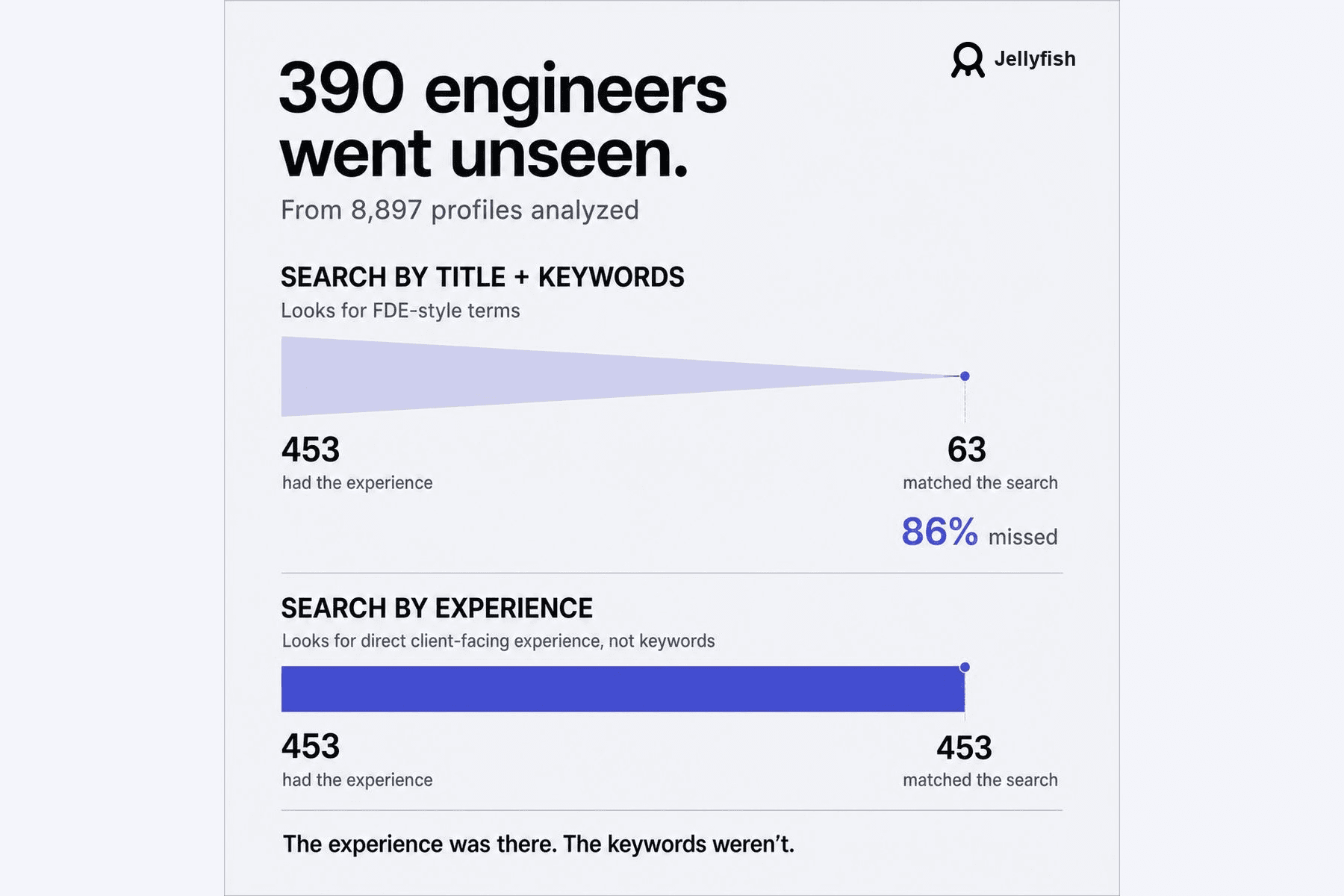
Out of 8,897 profiles, 453 engineers showed clear evidence of B2B customer-facing technical work.
Only 63 of them had an FDE-style title.
That means 390 engineers doing relevant work were hiding behind completely ordinary titles like Software Engineer and Product Engineer.
The experience is there. The keyword isn't.
This is the problem with title-based recruiting.
Titles are useful shortcuts, but they're a terrible representation of what someone actually does.
Two people can both be called Software Engineers while having completely different jobs.
One might spend every day working on internal infrastructure.
The other might be flying out to customer offices, integrating APIs, debugging production issues with a client's engineering team, and turning vague customer problems into shipped software.
On LinkedIn, they can look almost identical if you're only searching the title field.
For an FDE search, the second engineer could be an incredible candidate.
But a search for "Forward Deployed Engineer" will never find them.
Recruiters already know this
The interesting part is that this isn't really a recruiter judgment problem.
Give a strong technical recruiter ten profiles and they can usually tell you which candidates fit.
They'll notice things like:
- Worked closely with enterprise customers
- Built custom integrations
- Owned deployments
- Worked across product and engineering
- Took customer requirements and turned them into technical solutions
- Operated in ambiguous environments
- Spent meaningful time directly with users
None of those require the words Forward Deployed Engineer to appear anywhere on the profile.
The problem comes when you need to apply that judgment across 10,000 profiles.
At that scale, recruiters are forced to use proxies.
Job titles.
Keywords.
Boolean strings.
Companies.
And every proxy removes potentially great candidates from the search before a recruiter ever gets the chance to evaluate them.
Search for the work, not the title
The better way to source these candidates is to describe the person you're actually looking for.
Instead of:
Must have been a Forward Deployed Engineer.
You might define the search as:
A strong software engineer who has worked directly with B2B customers, owned technical implementations or integrations, and shipped solutions in customer environments.
Now the candidate pool changes completely.
The Software Engineer who built integrations for Fortune 500 customers becomes relevant.
The Product Engineer who spent half their time working directly with users becomes relevant.
The engineer at an infrastructure startup who owned enterprise deployments becomes relevant.
These candidates were always there.
The search just wasn't designed to find them.
This is what we're building Jellyfish around
Recruiters already have the judgment required to identify great candidates.
What doesn't scale is manually applying that judgment to thousands of profiles.
With Jellyfish, a recruiter describes what they're actually looking for.
We turn that judgment into structured criteria.
Then AI agents review the candidate pool against those criteria and show the evidence behind every match.
Not just:
“This candidate is a 92% fit.”
But:
“This candidate spent two years building customer integrations, worked directly with enterprise engineering teams, and owned deployments from requirements through production.”
The recruiter still decides what good looks like.
The AI just applies that judgment to every profile.
Because the best candidate for your Forward Deployed Engineer role might not be a Forward Deployed Engineer.
They might just be a Software Engineer who has been doing the job all along.
Your judgment, applied at scale.